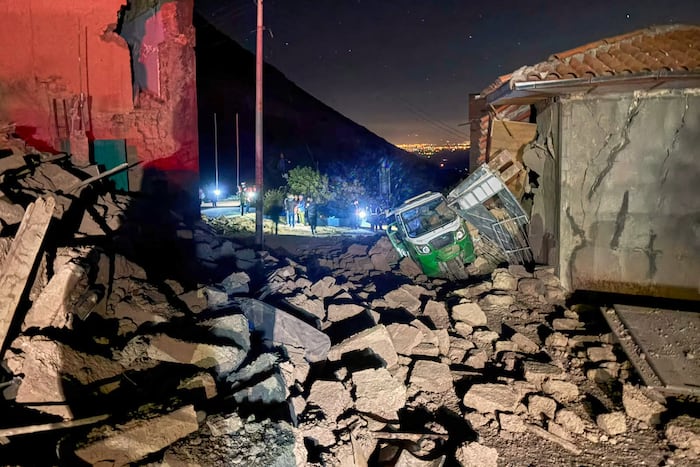
A devastating 5.5 magnitude earthquake rocked Peru’s Andes mountain region on Saturday, July 18, 2026, claiming the lives of at least five people and leaving a trail of destruction across several communities. The seismic event, which struck at 9:24 p.m. local time, has left more than 20 individuals injured and forced approximately 300 residents to flee their damaged homes.
According to the U.S. Geological Survey, the earthquake’s epicenter was located approximately 2 kilometers (1.24 miles) west-southwest of Sicaya, a city in Huancayo province. The tremor originated at a depth of 10 kilometers (6.21 miles), making it a relatively shallow earthquake that intensified the impact felt at the surface level.
Widespread Destruction and Missing Persons
Peru’s National Civil Defense Institute released a statement indicating that authorities are still working to determine the total number of missing persons in the affected areas. The earthquake caused significant structural damage throughout the region, with several buildings completely collapsing under the force of the tremor. Among the structures severely impacted were local religious buildings, including a church and convent that suffered extensive damage.
The agricultural community of Chongo Bajo emerged as one of the hardest-hit areas, where local television broadcasts captured heart-wrenching scenes of families dealing with the aftermath of the disaster. Residents were seen huddling under blankets outside their severely damaged homes, while rescue workers and volunteers searched through debris. Disturbingly, images also showed animals trapped beneath the rubble of collapsed structures.
“The use of rustic adobe materials in construction in that Andean area has contributed to the greater impact and damage,” explained Luis Vásquez, head of the local civil defense office, during a press conference addressing the disaster response efforts.
Survivors Share Their Stories of Loss
Among the countless stories of loss emerging from the disaster zone, Hermenegilda Guamalato’s account highlights the human toll of the earthquake. Speaking to a local radio station, the mother of three described the complete destruction of her family home and her desperate search for temporary shelter in the neighboring province of Huayucachi.
The earthquake’s impact has been particularly severe due to the traditional construction methods commonly used in Peru’s highland communities. Many homes in the Andes region are built using adobe, a mixture of mud and straw that, while culturally significant and environmentally friendly, offers limited resistance to seismic activity. This vulnerability has been a recurring concern for disaster preparedness officials throughout the country.
Emergency response teams have mobilized across the affected provinces to provide the following assistance:
- Search and rescue operations in collapsed buildings
- Medical attention for the injured at field hospitals
- Temporary shelter arrangements for displaced families
- Distribution of food, water, and essential supplies
- Structural assessments of damaged buildings
- Psychological support services for trauma victims
Peru’s Ongoing Seismic Vulnerability
Earthquakes are an unfortunate reality for Peru, which sits along the Pacific “Ring of Fire,” a horseshoe-shaped zone around the Pacific Ocean basin known for frequent seismic and volcanic activity. This geological positioning makes the South American nation particularly susceptible to earthquakes of varying magnitudes throughout the year.
The country’s seismic history includes numerous devastating events that have shaped both its infrastructure development and emergency response protocols. Most notably, a catastrophic 7.9 magnitude earthquake struck the province of Pisco in the Ica region in 2007, resulting in nearly 600 deaths and causing widespread destruction that took years to rebuild.
While the July 18 earthquake was significantly smaller in magnitude than the 2007 Pisco disaster, its impact on the affected Andean communities underscores the ongoing need for improved building standards and earthquake preparedness measures in vulnerable regions. Local and national authorities continue to coordinate relief efforts as the search for missing persons continues and families begin the long process of rebuilding their lives in the wake of this latest natural disaster.