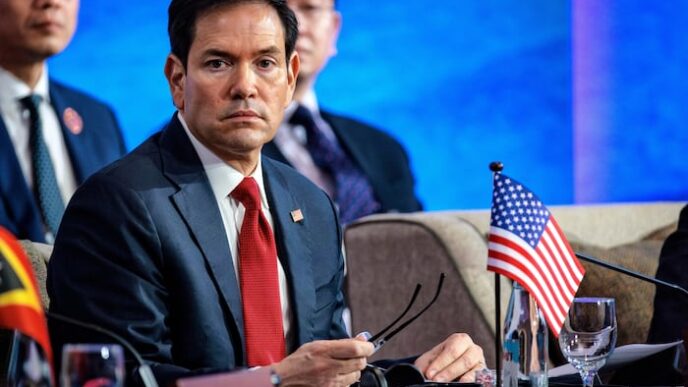
Secretary of State Marco Rubio delivered a stark warning to Asian leaders on July 22, 2026, emphasizing that allowing Iran to control the strategically vital Strait of Hormuz and impose tolls on international shipping would establish a perilous precedent with far-reaching consequences for global maritime security and economic stability.
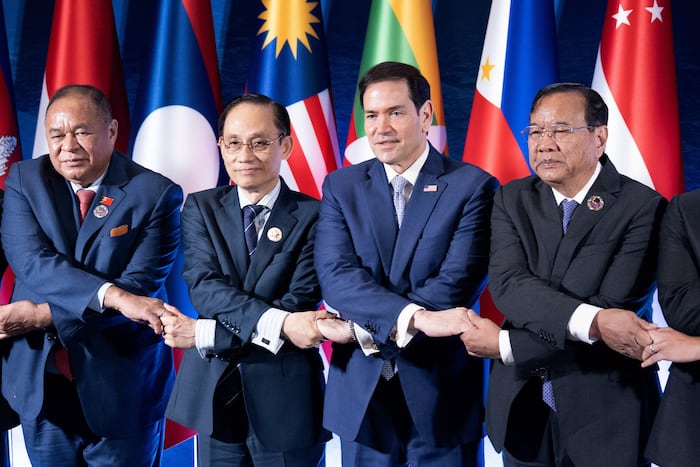
Speaking at the Association of Southeast Asian Nations (ASEAN) annual ministerial meeting in Manila, Philippines, Rubio addressed growing concerns among regional partners about the escalating conflict in the Middle East and its potential ripple effects across the Indo-Pacific region.
A Warning Against Maritime Coercion
The top American diplomat painted a vivid picture of the dangers posed by allowing any nation to unilaterally claim control over international waterways. His message was clear: what happens in the Strait of Hormuz could serve as a blueprint for similar aggressive actions elsewhere in the world.
“If we create a precedent in the Middle East where a nation state can decide that they are going to control an international waterway, charge a toll and if you don’t pay them, blow up your ships, we have created a very dangerous precedent which will repeat itself in other parts of the world, including in this region.”
This warning resonated particularly strongly with ASEAN nations, many of which are embroiled in their own maritime disputes in the South China Sea. The Philippines, Vietnam, Malaysia, and Brunei all have competing territorial claims in waters where China has increasingly asserted its dominance through aggressive tactics.
Quad Partnership Reinforces Indo-Pacific Commitment
Beyond the ASEAN gathering, Rubio participated in a crucial meeting with foreign ministers from the Quad partnership, which brings together the United States, Australia, India, and Japan. The four-nation alliance focused on several key priorities during their discussions:
- Technology cooperation and development
- Humanitarian assistance coordination
- Emergency response capabilities
- Maritime security initiatives
- Transnational security challenges
The Quad leaders issued a joint statement reinforcing their shared commitment to maintaining peace and stability in the Indo-Pacific maritime domain. The alliance has become increasingly important as a counterbalance to China’s growing influence in the region.
“We are united in our conviction that peace and stability in the Indo-Pacific maritime domain underpin the security and prosperity of the region,” the leaders declared in their official statement. Rubio subsequently announced on social media platform X that the Quad would convene again later in the year, underscoring the partnership’s ongoing significance to American foreign policy.
U.S.-India Relations and Trade Progress
In a separate bilateral meeting, Rubio sat down with Indian External Affairs Minister Subrahmanyam Jaishankar to discuss both regional security concerns and the ongoing conflict involving Iran. The two diplomats also addressed the status of trade negotiations aimed at reducing tariffs imposed by President Donald Trump on Indian goods.
According to State Department spokesperson Tommy Pigott, both sides expressed optimism about the progress being made on commercial matters. “The Secretary and Minister Jaishankar agreed on the importance of finalizing the interim trade deal, which is almost complete,” Pigott confirmed.
High-Stakes Diplomacy in Manila
The Philippine capital has transformed into a hub of high-stakes diplomacy this week, with top officials from major world powers converging for the ASEAN-led discussions. Among the notable attendees:
- U.S. Secretary of State Marco Rubio
- Chinese Foreign Minister Wang Yi
- Russian diplomatic representatives
- Newly appointed British Foreign Secretary Ed Miliband
Rubio was scheduled to hold a separate meeting with Chinese Foreign Minister Wang Yi on the sidelines of the conference, which is taking place in a heavily secured convention complex along Manila Bay. The Trump administration has been vocal in criticizing Beijing’s increasingly assertive actions in the South China Sea, particularly those affecting the Philippines, America’s oldest treaty ally in the Asian region.
Despite the administration’s intense focus on the Middle East conflict, Rubio sought to reassure regional partners of Washington’s unwavering commitment to the Indo-Pacific. “We’re with ASEAN 100%,” he declared, attempting to allay concerns that American attention might be diverted away from Asian security interests.
The three-day diplomatic marathon, which began on July 21, 2026, continues to address the complex web of territorial disputes and security challenges facing the region. For Miami’s Latin American community, many of whom maintain strong business and family ties to the Philippines and other Asian nations, the outcomes of these discussions could have significant implications for international trade and regional stability.