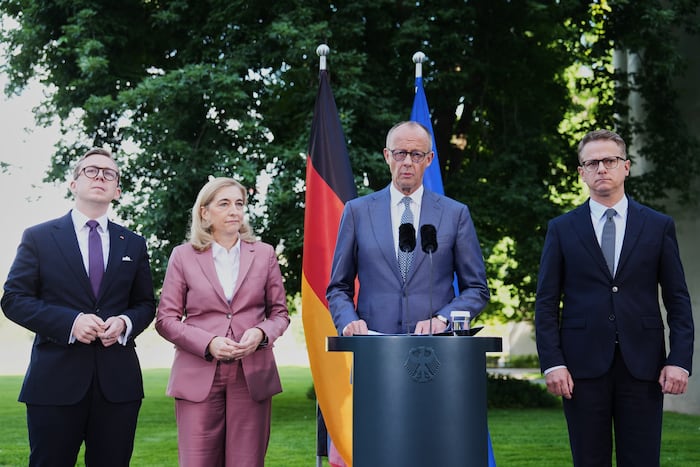
German Chancellor Friedrich Merz announced a significant reshuffling of his government’s top positions on July 24, 2026, in a strategic move aimed at reinvigorating his struggling administration ahead of crucial regional elections. The far-right Alternative for Germany (AfD) party continues to gain momentum, potentially positioning itself to claim its first state governorship in the country’s history.
A Government Under Pressure Seeks Fresh Start
The cabinet reshuffle comes at a critical moment for Merz, who has seen his popularity plummet to historic lows since taking office less than 15 months ago. His coalition government, which brings together the center-right Union bloc and the center-left Social Democrats — two historically rival parties — has struggled to convince German voters that it can deliver meaningful economic results.
The changes were triggered after a senior ally resigned as leader of the parliamentary group due to personal conduct issues that compromised his position. Merz seized this opportunity to implement broader changes to his leadership team, though his presentation of an incomplete set of reforms raised eyebrows among political observers and risked undermining the intended message of renewed vigor.
“The personnel changes follow a clear line. We want a government that works with great vigor and pleasure and also represents the personal diversity of our society and politics. We are a reform government and want to continue showing that,” Merz stated during his announcement.
Key Personnel Moves in the German Government
The reshuffle includes several notable appointments that Merz hopes will inject new energy into his administration:
- Thorsten Frei, the current chief of staff, will assume leadership of the Union bloc’s parliamentary group
- Health Minister Nina Warken will replace Frei at the chancellery, becoming the first woman to hold this crucial position
- Carsten Linnemann, general secretary of Merz’s Christian Democratic Union party, will take over as the new health minister
Warken’s appointment to the chancellery position is particularly significant. She recently guided the government’s first major reform through parliament — legislation designed to curb rising costs in Germany’s health insurance system. Merz praised her negotiating skills and her familiarity with security policy matters that are central to the chancellery’s responsibilities.
The Surrogacy Scandal That Forced Change
The immediate catalyst for the reshuffle was the resignation of Jens Spahn, who had served as leader of the Union’s parliamentary group — one of the coalition’s most powerful positions. Spahn stepped down after news emerged that he and his husband had utilized surrogacy services in the United States to have a child.
The revelation proved particularly damaging because surrogacy is prohibited under German law, and Merz’s party has consistently opposed legalizing the practice. The party reaffirmed this position at a convention in February 2026. Making matters worse, Spahn himself had previously spoken publicly against surrogacy, leading to widespread accusations of hypocrisy and double standards that became impossible to ignore.
Far-Right Gains Threaten Traditional Parties
The governing coalition faces three challenging regional elections in September 2026. The most significant takes place on September 6 in the eastern region of Saxony-Anhalt, where the AfD is polling strongly enough to potentially win a majority. Such a victory would give the far-right party control of a state government for the first time in German history — a prospect that alarms mainstream political forces across Europe.
The AfD’s rise has been fueled by widespread voter discontent with the current government’s performance. Despite Merz’s promises to reform and revitalize Germany’s economy — the largest in Europe — the much-anticipated economic turnaround has been painfully slow to materialize after years of stagnation. Months of visible coalition infighting further eroded public confidence in the government’s ability to govern effectively.
Reform Agenda Attempts to Win Back Voters
In recent weeks, the Merz government has unveiled ambitious reform proposals in an attempt to demonstrate decisive leadership:
- A comprehensive overhaul of Germany’s pension system, including a gradual increase in the retirement age
- Income tax reductions targeting low- and middle-income earners
- A significant effort to reduce bureaucratic red tape that has long been criticized by businesses
Merz declared just days before the reshuffle announcement that his government had “found its rhythm” and was delivering results despite criticism. However, the sudden personnel crisis that followed immediately tested that optimistic assessment, leaving German voters and political analysts wondering whether the chancellor can truly stabilize his government before the crucial September elections determine the future balance of power in German politics.