In a significant legal development that directly impacts millions of voters across the nation, a federal appeals court has upheld an injunction blocking President Donald Trump’s executive order to create a federal list of eligible voters. The ruling, issued over the weekend of July 26-27, 2026, rejected the administration’s efforts to implement mail-in voting restrictions ahead of November’s midterm elections.
Understanding the Federal Voter List Decision
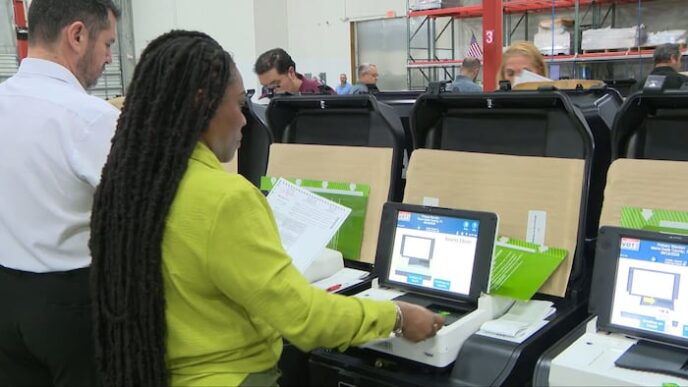
The court’s decision affects 23 U.S. states that filed lawsuits challenging the executive order, which would have limited mail ballot delivery exclusively to individuals appearing on a federal voter list. For Miami’s vibrant Latin community, where mail-in voting has become an essential tool for civic participation, this ruling preserves current voting accessibility options.
“The SAVE Act has to be done. They shouldn’t leave town,” President Trump told reporters aboard Air Force One, continuing to pressure Senate Majority Leader Thune to pass voting restrictions legislation before the August recess.
The federal voter list controversy represents one of the most contentious political battles of 2026, with implications that extend far beyond Washington. Florida residents, particularly those in Miami-Dade County’s diverse neighborhoods, have historically relied on various voting methods to exercise their democratic rights. Understanding these legal developments helps our community stay informed and prepared for upcoming elections.
Clean Energy Grants Canceled Based on Political Affiliation
In a separate but equally significant revelation, court documents have exposed that the Trump administration canceled $7.6 billion in grants for hundreds of clean energy projects. The administration acknowledged these cancellations were made based solely on the political identity of the grant recipient’s state, specifically targeting 16 states that voted for Democrat Kamala Harris in the 2024 presidential election.
This decision affects numerous environmental initiatives and job opportunities in affected states. For Miami residents concerned about climate resilience and sustainable development, particularly given South Florida’s vulnerability to rising sea levels and extreme weather, these funding cuts represent a significant policy shift worth monitoring.
International Tensions Rise at United Nations
The week also witnessed unusual diplomatic friction between the United States and France at the United Nations. On July 27, 2026, the U.S. delegation walked out of a UN Security Council meeting on Ukraine when France began speaking, protesting French criticism of American human rights policies.
U.S. deputy ambassador Dan Negrea responded to French criticism by calling the United States “the beacon of liberty for the world.” The dispute stemmed from France’s comments about a General Assembly vote where the U.S. opposed extending UN human rights chief Volker Turk’s term. Key points from the diplomatic exchange include:
- The General Assembly voted 144-10 to extend the human rights chief’s term
- The U.S. voted against the extension alongside countries including North Korea and Russia
- France’s UN Mission criticized the U.S. position on social media
- The U.S. accused France of “disingenuous grandstanding”
Defense and International Security Updates
President Trump addressed concerns about U.S. military stockpiles during his flight to Michigan on July 27, 2026, stating that defense supplies are in “very good shape” while acknowledging a desire for expanded production capacity. The president noted that military contractors are currently building multiple production facilities to increase output of sophisticated weapons systems.
Regarding allegations that Russia has been providing satellite imagery of U.S. bases in the Gulf region to Iran, President Trump downplayed the significance of such assistance. Ukrainian President Volodymyr Zelenskyy, scheduled to meet with Trump on July 28, 2026, first raised these concerns publicly. The president indicated he would raise the matter directly with Russian President Vladimir Putin.
What This Means for Miami’s Latin Community
These federal developments carry significant weight for Miami residents planning to participate in the November midterm elections. The preserved injunction against the federal voter list ensures that current voting procedures remain intact, at least temporarily. Community members should stay informed about any changes to voting requirements and deadlines.
For those interested in civic engagement, local organizations throughout Miami-Dade County continue offering voter registration assistance and educational resources. Whether you prefer voting by mail, early voting, or casting your ballot on Election Day, understanding your options empowers you to make your voice heard in our democracy.